Absorbed and metabolized
A small study administered individual catechins, including EGC. It measured exposure and a blood antioxidant assay, not digestive health or disease prevention. [1]
 SCIENCE / SUPPORTING ACTIVES
GUT-SUPPORTING ACTIVES / RESEARCH REVIEW
Inulin has human evidence for feeding certain gut bacteria and supporting bowel regularity at gram-level doses. Epigallocatechin has human absorption research, but much less evidence for clinical benefits on its own.
Explore the evidenceAn ingredient review, not proof of benefit for the Neurogan Akkermansia blend. EGC is not EGCG.
01 / EPIGALLOCATECHIN · EGC
Epigallocatechin (EGC) and epigallocatechin gallate (EGCG) are distinct molecules. EGCG has an added gallate group. Epicatechin (EC) is another distinct catechin. The current product label says epigallocatechin; this review does not silently rename it EGCG. [1] [8]
A small study administered individual catechins, including EGC. It measured exposure and a blood antioxidant assay, not digestive health or disease prevention. [1]
Measuring EGC in blood after tea does not isolate its health effects. Tea contains several catechins and other compounds. [2]
This focused search did not identify a controlled trial establishing isolated EGC benefits for gut symptoms, weight or metabolic health. That is a gap, not proof that it has no effect.
Van Amelsvoort et al., 2001: ten healthy volunteers received single oral doses of individual catechins in a randomized crossover study. EGC appeared in plasma and was cleared relatively quickly. This demonstrates human exposure, not a proven supplement benefit. [1]
Intervention: 1.5 mmol of EGC, epicatechin gallate or EGCG on separate occasions. The abstract describes catechin comparisons, not a placebo efficacy comparison. The original molar dose is retained rather than treating it as a 100 mg product-dose match.
Measured: plasma and 24-hour urinary catechins after deconjugation, using HPLC; plasma ferric reducing activity (FRAP), an antioxidant-capacity assay. EGC peak concentration was 5.0 µmol/L and elimination half-life 1.7 hours. EGC returned to baseline by 24 hours. These are pharmacokinetic measurements, not an onset or duration of gut benefit.
Positive laboratory signal: EGC increased measured plasma antioxidant activity. However, FRAP closely tracked uric acid (R² = 0.88, p < 0.0001). The assay cannot be read as a quantified improvement in health or proof of direct antioxidant protection in tissues.
Limits: ten participants, single doses, no digestive or long-term clinical endpoint. Full methods, adverse-event tables and formulation specifications were not accessed. The listed affiliation is Unilever Research. Access: primary abstract.
Lee et al., 2002: eight participants received a single oral dose of green tea or decaffeinated green tea at 20 mg tea solids/kg, or purified EGCG at 2 mg/kg. The purified arm was EGCG, not EGC. Plasma and urine catechins were measured by HPLC. [2]
EGC in plasma was mostly conjugated, unlike EGCG, which was mostly free. There was substantial between-person and repeat-experiment variability. This supports keeping chemical identity and formulation separate; it does not demonstrate microbiome improvement, weight loss, glucose control or cancer prevention.
Access: primary abstract. No efficacy magnitude or capsule-equivalent dose is inferred from tea-solids exposure.
The small acute EGC study is not a long-term safety study. The evidence reviewed does not establish a safe chronic isolated-EGC dose, pregnancy safety or safety with medicines. A different molecule is not automatically a safer molecule.
EFSA's 2018 assessment found liver-enzyme elevations in supplement trials at or above 800 mg EGCG/day and could not identify an EGCG extract dose considered safe. That figure concerns EGCG, not an EGC limit or an EGC-to-EGCG conversion. Brewed tea and concentrated extracts also differ. We do not use this assessment to claim that 100 mg EGC is either toxic or proven safe. [7]
If you have liver disease, are pregnant or breastfeeding, or take medicines, discuss the entire blend with a qualified clinician before use. Its other ingredients matter too. Stop use and seek medical advice for concerning symptoms such as yellowing skin or eyes, dark urine or persistent abdominal pain.
02 / INULIN · FERMENTABLE FIBER
Inulin is a fermentable fiber, not a live probiotic. Human trials show increases in bifidobacteria and some improvement in stool frequency. A bacterial marker is not automatically a clinical benefit, and neither finding establishes efficacy at 20 mg per capsule. [3] [4]
Both doses increased fecal bifidobacteria versus placebo over two weeks in healthy adults. No clear dose-response advantage was observed. [3]
A four-week trial in adults with constipation reported median stool frequency of 4.0 versus 3.0 stools/week with placebo. [4]
20 mg is well below these study exposures. A shared ingredient name does not bridge that gap. Do not increase capsule intake to chase a fiber-study dose. Compare the formula
Kolida et al., 2007: 30 healthy adults, ages 19–35, took inulin or maltodextrin in chocolate drinks. Both tested inulin doses had a bifidogenic effect, meaning they increased the measured bacterial population. [3]
Design: double-blind, placebo-controlled crossover; 15 men and 15 women. Each treatment lasted two weeks with a one-week washout. Treatments were 5 g/day inulin, 8 g/day inulin and 8 g/day maltodextrin.
Endpoint: fecal bifidobacteria measured by fluorescence in situ hybridization. Abstract-reported levels were 9.78 ± 0.29 at 5 g/day, 9.79 ± 0.38 at 8 g/day and 9.64 ± 0.23 with placebo, in log₁₀ cells/g feces. Reported comparisons: p < 0.05 and p = 0.05, respectively. The abstract does not define the ± measure, so no uncertainty chart is drawn.
The authors found no dose-response effect; response depended on starting bacterial levels. These logarithmic bacterial counts are not percentages of health improvement. The trial did not establish a minimum effective dose, symptom relief, increased Akkermansia or efficacy for this blend. Access: primary abstract; complete adverse-event and funding details not reviewed.
Micka et al., 2017: 44 volunteers with constipation were studied using chicory-derived Orafti® Inulin at 12 g/day. After four weeks, the inulin treatment median was 4.0 stools/week versus 3.0 with placebo. This is a treatment-period comparison, not a before-and-after change for an individual. [4]
Design: randomized, double-blind, placebo-controlled crossover. Each period included a run-in followed by four weeks taking 4 g three times daily, with maltodextrin as placebo and a two-week washout between periods. The abstract describes 44 volunteers but does not provide all endpoint-specific denominators.
Result: inulin median 4.0 stools/week, interquartile range 2.5–4.5; placebo median 3.0, IQR 2.5–4.0; p = 0.038. Stool softening was described without a numerical estimate in the accessed abstract. Satisfaction was only a trend (p = 0.059), not a statistically significant benefit.
Limits: short duration, selected constipation population, specific branded fiber. No proof for a low-milligram capsule blend, all causes of constipation or long-term outcomes. Two authors list BENEO-Institute affiliations. Access: primary abstract; detailed safety tables and full methods not reviewed.
Puhlmann et al., 2025: a 12 g/day chicory-inulin trial reported improved stool frequency, but effects from the first treatment period appeared to carry into the next. That complicates how confidently the crossover result can be interpreted. [5]
Design: 40 randomized; the abstract describes 39 individuals. Full text reports one dropout, a second participant excluded after unaccounted symptom improvement, and incomplete bowel diaries for five participants; all available data were analyzed. Sample availability varies by endpoint, so 39 is not assumed for every result. Participants had Rome III functional constipation. Double-blind crossover, four weeks per treatment, four-week washout; inulin versus maltodextrin. This is a separate trial, not a follow-up of the Micka participants.
Table 1: modeled change in stool frequency was +1.43 with inulin and +0.90 with placebo, for a between-treatment difference of +0.53 stools/week (95% CI 0.02 to 1.04; p = 0.046). The table explicitly flags this p-value as biased by the intervention-by-period interaction. It should not be treated as an uncomplicated confirmatory result.
Mixed findings: stool consistency was not significantly different in the crossover analysis (p = 0.600, also interaction-flagged). Quality-of-life and selected symptom outcomes favored inulin. Microbiota responses varied by participant and sequence. A first-period-only reanalysis supported benefit, but does not erase the crossover limitation.
Access: primary full text, including Table 1 and its footnotes. The trial had inulin-industry involvement. No pooled result, percentage improvement or predicted product response is inferred.
Bonnema et al., 2010: a controlled challenge study found that native inulin and shorter-chain oligofructose differed in tolerance. Flatulence was the most common symptom, followed by bloating. [6]
Design: randomized, double-blind, controlled crossover in 26 healthy adults ages 18–60 without a history of GI conditions. Five breakfast challenges tested native inulin at 5 and 10 g, oligofructose at 5 and 10 g, and placebo. GI questionnaires were completed at 0, 2, 4, 24 and 48 hours.
Both fibers tended to mildly increase symptoms. The 10 g oligofructose condition substantially increased GI symptoms versus control. The authors described native inulin up to 10 g and oligofructose up to 5 g as well tolerated in this population. This does not mean symptom-free or establish long-term daily tolerance.
Limits: short challenges in healthy adults, not a chronic-use trial in people with IBS or other GI disorders. The accessed abstract gives no numerical symptom effect sizes. Inulin chain length and formulation can matter; the Neurogan label does not establish a match to either tested fiber. Access: primary abstract.
Gas, bloating and abdominal discomfort can accompany fermentation, especially with larger fiber intakes. People who are sensitive to fermentable carbohydrates or already have digestive symptoms may tolerate inulin differently from the healthy volunteers in the challenge study.
Clinical gram-level studies are not instructions to take more of a multi-ingredient supplement. A clinician can help distinguish dietary fiber needs from symptoms requiring investigation. Persistent or severe constipation, bleeding, unexplained weight loss or significant abdominal pain deserves medical assessment rather than supplement escalation.
03 / LABEL TO LITERATURE
The Neurogan Akkermansia product is an oral multi-ingredient capsule. These studies used single catechins, tea or gram-level fiber preparations. None of the cited trials tested the finished Neurogan blend. Read the Akkermansia evidence page →
| Ingredient / route | Current label | Human studies reviewed | What transfers? |
|---|---|---|---|
| Epigallocatechin / oral | 100 mg EGC per capsule; 100–200 mg across the listed 1–2 capsule daily directions. | Individual-catechin trial: 1.5 mmol EGC, single dose. Tea PK trial: tea mixture or isolated EGCG, not isolated EGC. | Human absorption is documented; clinical efficacy and chronic safety at the product dose are not established. |
| Inulin / oral | 20 mg = 0.02 g per capsule; 20–40 mg = 0.02–0.04 g across listed daily directions. | 5 or 8 g/day for two weeks (bacterial marker); 12 g/day for four weeks (constipation). | Gram-level fiber findings do not substantiate the same benefit at milligram-level exposure. |
| Finished blend / oral | EGC and inulin alongside Akkermansia, NMN, berberine and trans-resveratrol. | No controlled human trial of this exact formula identified in this focused review. | No established synergy, optimal ratio, combined long-term safety or predicted benefit size. |
Do not convert study doses into capsule instructions. Taking extra capsules also increases all the other ingredients. The review does not recommend dose escalation.
The current Supplement Facts panel lists one capsule with Akkermansia 150 mg (30 billion CFU), NMN 150 mg, berberine 100 mg, epigallocatechin 100 mg, trans-resveratrol 50 mg and inulin 20 mg. The product directions list 1–2 capsules daily. This hub uses the exact EGC wording; it does not independently verify purity, stereochemistry, extract composition or any EGCG content.
Inulin source and chain-length equivalence to the studied preparations are not established by this panel. The Akkermansia page discusses separate microbial identity and formulation limitations.
Open the full-size Supplement Facts image ↗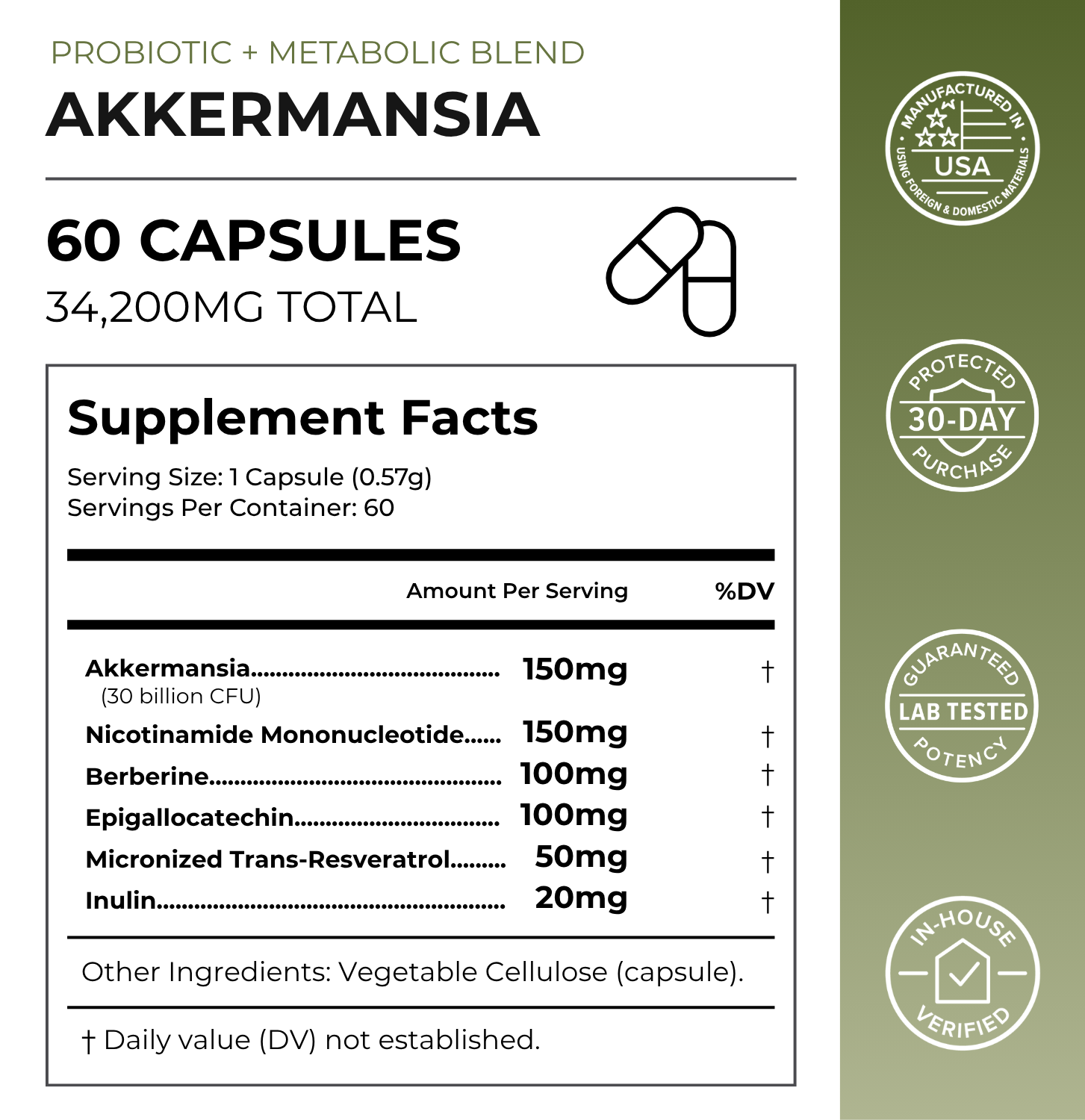
Manufacturer product listing ↗ · Catalog context, not a recommendation.
THE TAKEAWAY
Inulin has credible human prebiotic research at doses far above this capsule's amount. EGC has direct human pharmacokinetic evidence, but an unproven clinical role here. Neither justifies borrowing the broader reputation of green tea or a different formula.
Follow the original sources ↓04 / SOURCES & ACCESS
A focused evidence review, not a systematic review or treatment recommendation. Primary abstracts are identified separately from full-text review. Abstract-only sources do not establish complete safety, funding or endpoint details. Searches distinguished EGC from EGCG and looked for direct human ingredient and combination evidence. No numerical efficacy chart is synthesized.
Plasma concentrations of individual tea catechins after a single oral dose in humans. Xenobiotica 31:891–901. PMID 11780763. DOI: 10.1080/00498250110079149. Ten-person crossover; EGC exposure and FRAP, not clinical gut efficacy.
Read the primary abstract ↗Pharmacokinetics of tea catechins after ingestion of green tea and (-)-epigallocatechin-3-gallate by humans: formation of different metabolites and individual variability. Cancer Epidemiology, Biomarkers & Prevention 11:1025–1032. PMID 12376503. Eight participants; EGC measured after a mixture, not isolated-EGC efficacy.
Read the primary abstract ↗A double-blind placebo-controlled study to establish the bifidogenic dose of inulin in healthy humans. European Journal of Clinical Nutrition 61:1189–1195. PMID 17268410. DOI: 10.1038/sj.ejcn.1602636. Thirty participants; 5 and 8 g/day.
Read the primary abstract ↗Effect of consumption of chicory inulin on bowel function in healthy subjects with constipation: a randomized, double-blind, placebo-controlled trial. International Journal of Food Sciences and Nutrition 68:82–89. PMID 27492975. DOI: 10.1080/09637486.2016.1212819. Forty-four volunteers; 12 g/day.
Read the primary abstract ↗Inulin-induced improvements on bowel habit and gut microbiota in adults with functional constipation: findings of a randomized, double-blind, placebo-controlled study. BMC Gastroenterology. PMID 41233756. DOI: 10.1186/s12876-025-04409-6. Table 1 and interaction footnotes reviewed; carryover caveat preserved.
Read the full article ↗Gastrointestinal tolerance of chicory inulin products. Journal of the American Dietetic Association 110:865–868. PMID 20497775. DOI: 10.1016/j.jada.2010.03.025. Twenty-six healthy adults; acute fiber challenges with 48-hour symptom follow-up.
Read the primary abstract ↗Scientific opinion on the safety of green tea catechins. EFSA Journal 16:5239. DOI: 10.2903/j.efsa.2018.5239. Full-text conclusions accessed. EGCG/extract safety assessment, not an isolated-EGC safe-dose determination or a statement of current law.
Read the scientific opinion ↗NIH PubChem CID 72277. Chemical identity reference, not an efficacy trial or a certificate of analysis for the product.
View the chemical record ↗