Live bacteria
CFU means colony-forming units: a culture-based estimate of organisms able to grow under specified conditions. Strain, storage and shelf-life viability matter.
 SCIENCE / RESEARCH REVIEW
GUT MICROBE · FORMULATION MATTERS
Akkermansia research has moved beyond laboratory promise. Some pasteurized preparations have improved selected metabolic outcomes or limited weight regain. Larger trials also show important null results, and the product on the shelf may be a very different formulation.
See the measured resultsIngredient and formulation research, not proof of finished-product results. Reviewed 10 September 2026.
THE RESULTS, IN PLAIN ENGLISH
Insulin sensitivity can be measured in several ways. A favorable small pilot and a later null primary result belong side by side. Low-baseline-microbe subgroup findings are interesting, but they do not erase the overall result.
TWO DIFFERENT ANSWERS TO TWO DIFFERENT TESTS
2019 pilot, pasteurized versus placebo.
± 7.02% SEM; p = 0.002.
12 pasteurized and 11 placebo completers. [1]
2026 multicenter trial, four months.
30 billion pasteurized cells daily.
Primary Matsuda-index target not met. [2]
UNDERSTANDING THE INGREDIENT
CFU means colony-forming units: a culture-based estimate of organisms able to grow under specified conditions. Strain, storage and shelf-life viability matter.
Heat-treated cells are not a live probiotic. Studies can quantify cells or fluorescent units even when organisms no longer form colonies. Pasteurized MucT cannot be matched to a CFU label by number alone.
Active fluorescent units (AFU), total fluorescent units (TFU), total cells and CFU use different measurement methods. They are not universal conversion factors. A blend with several other actives needs its own evidence.
A CLOSER LOOK AT THE HUMAN RESEARCH
Positive findings, null results and reviews are shown together. Open any study for the population, dose, duration and limitations. Every summary is available without JavaScript.
DEPOMMIER · 2019 · EXPLORATORY TRIAL
Insulin sensitivity improved in a small pasteurized-bacteria group. Weight loss was not statistically established. [1]
Read the source · Primary full text
SUENAERT · 2026 · MULTICENTER TRIAL
The overall four-month result was null. Low-baseline-Akkermansia subgroups remain a research lead. [2]
Read the source · Primary full text
ZHANG · 2025 · RANDOMIZED TRIAL
Body weight and HbA1c fell in both groups without a significant overall treatment difference. [3]
Read the source · Primary abstract
MOUNT · 2026 · RANDOMIZED TRIAL
A pasteurized MucT preparation helped limit regain after a structured low-energy diet. [4]
Read the source · Primary abstract and publisher preview
ROSHANRAVAN · ONLINE 2021 · SYSTEMATIC REVIEW
Early evidence was promising, but human and rodent research must not be pooled into a consumer benefit claim. [5]
Read the source · Systematic review, abstract
This is a selected evidence review, not an exhaustive systematic review of every possible use. A review can contain the trials shown above; those are not additional independent experiments. A p-value describes statistical evidence, not the size or importance of a benefit.
FROM THE STUDY TO THE LABEL
Current catalog labels are product information, not independent proof of efficacy, identity, potency or bioequivalence. No finished Neurogan product below was the intervention in the cited trials.
Supplement Facts: One capsule: Akkermansia 150 mg (30 billion CFU), NMN 150 mg, berberine 100 mg, epigallocatechin 100 mg, micronized trans-resveratrol 50 mg and inulin 20 mg.
Directions: Directions: one or two capsules daily. The full listed blend is 570 mg per capsule; that is not 570 mg of Akkermansia.
Research comparison: The visible label does not specify strain, pasteurization status, culture/viability method or CFU guarantee at expiry. “Epigallocatechin” is not automatically EGCG. A 30-billion-CFU mixture is not the 30-billion-cell pasteurized trial preparation.
Current product listing · Original label image
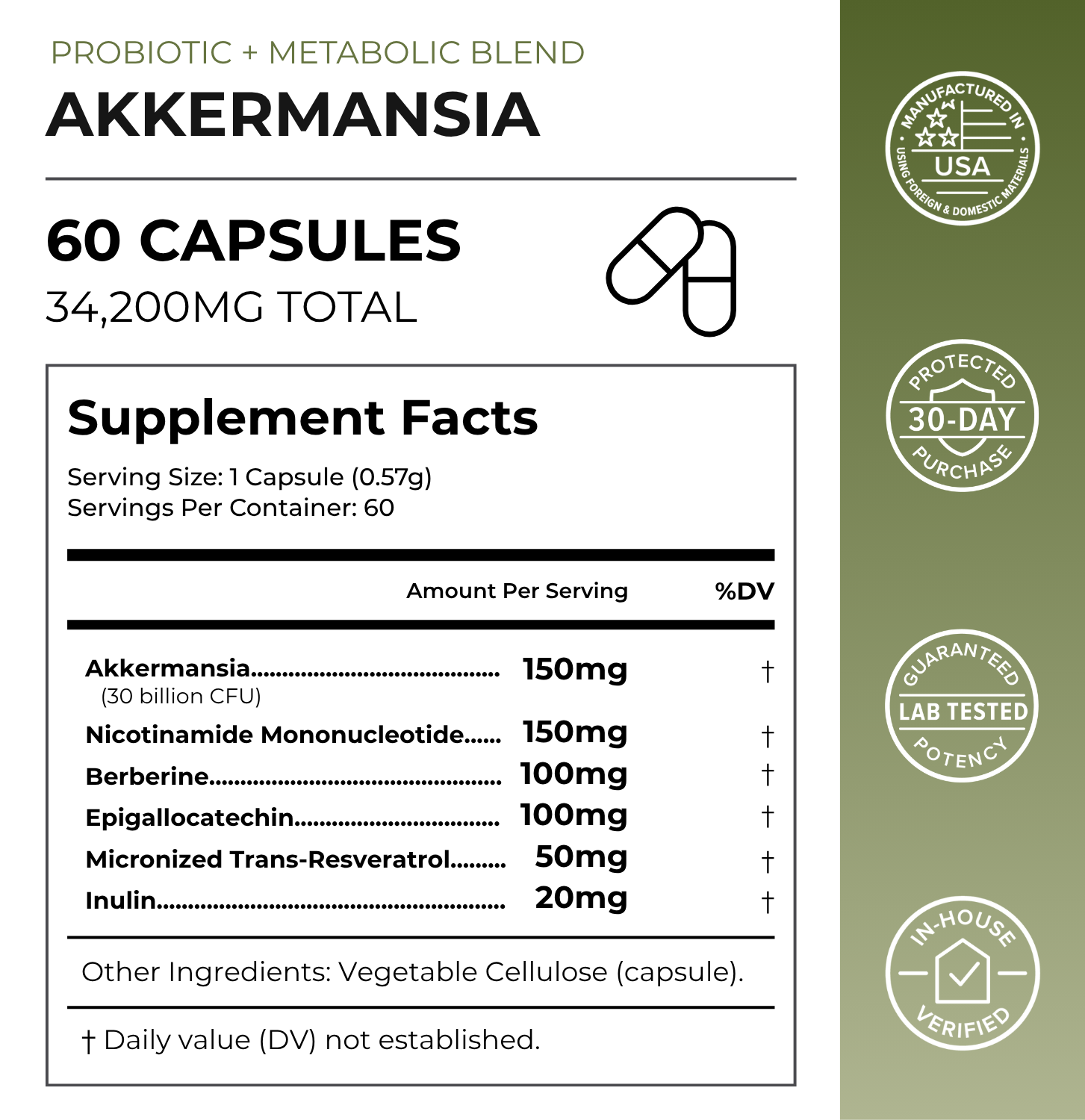
This is the label image linked by the live product record when reviewed on 10 September 2026.
Serving size and daily directions are listed separately. A dose similarity is not evidence that a different formula produces the same outcomes.
Labels and listings can change. Check the package you receive and discuss individual use with a qualified clinician.
SAFETY AND REALISTIC EXPECTATIONS
The cited trials reported generally acceptable short-term tolerability in their selected populations. That does not establish safety in severely immunocompromised or critically ill people, or for every live strain. The catalog blend also contains NMN, berberine, epigallocatechin, resveratrol and inulin. Medication interactions, gastrointestinal tolerance and pregnancy precautions therefore cannot be assessed from an Akkermansia-only trial. Ask a qualified clinician before use, especially during pregnancy or breastfeeding, with glucose-lowering medicines, or with major illness. The label does not settle the live-versus-pasteurized question.
This page is educational, not a diagnosis, treatment plan or individualized dose recommendation. Do not stop prescribed treatment or replace established care on the basis of a biomarker result. “No significant difference” does not prove two treatments are equivalent, and “well tolerated” in a small trial does not rule out rare harms.
Bring the full ingredient list, medicines and health history to a clinician or pharmacist. In a blend, the safety question concerns every ingredient together, not only the name on the front label.
REFERENCES AND ACCESS
Links lead to primary publications or systematic reviews. Access limitations are stated rather than filled with assumed methods or outcomes. Product comparisons use the live product records and linked label images above.
The original pilot favored the pasteurized form. Access reviewed: Primary full text.
Open publication · Return to study summaryA larger trial missed its main insulin-sensitivity target. Access reviewed: Primary full text.
Open publication · Return to study summaryLive strain research also shows a mixed overall result. Access reviewed: Primary abstract.
Open publication · Return to study summaryLess regain after weight loss, not weight loss from a capsule alone. Access reviewed: Primary abstract and publisher preview.
Open publication · Return to study summaryA systematic review, largely a foundation for later trials. Access reviewed: Systematic review, abstract.
Open publication · Return to study summary