What it is
Trans-resveratrol is a plant polyphenol. Foods, extracts, isolated trans-resveratrol and micronized preparations do not automatically provide the same exposure.
 SCIENCE / RESEARCH REVIEW
A PLANT POLYPHENOL, TESTED IN PEOPLE
Resveratrol has produced encouraging metabolic and cognitive findings in selected groups. Other well-controlled trials found no benefit. The useful question is not whether it is “anti-aging,” but what it actually changed in people.
See the measured resultsIngredient and formulation research, not proof of finished-product results. Reviewed 10 September 2026.
THE RESULTS, IN PLAIN ENGLISH
The clearest way to read this result is modestly: an indirect insulin-resistance marker was lower during the resveratrol period. It does not tell us how much a particular person’s health would improve.
HOMA index • lower is favorable
UNDERSTANDING THE INGREDIENT
Trans-resveratrol is a plant polyphenol. Foods, extracts, isolated trans-resveratrol and micronized preparations do not automatically provide the same exposure.
Cell and animal work points to stress-response and metabolic pathways. A pathway is a reason to run a trial, not a measured benefit in people.
More energy, fat loss, disease prevention and longer life require their own clinical outcomes. A higher dose or smaller particle size is not evidence of a larger benefit.
A CLOSER LOOK AT THE HUMAN RESEARCH
Positive findings, null results and reviews are shown together. Open any study for the population, dose, duration and limitations. Every summary is available without JavaScript.
TIMMERS · 2011 · CROSSOVER TRIAL
Selected metabolic markers improved after a month of resveratrol. The study did not show weight loss. [1]
Read the source · Primary full text
POULSEN · 2013 · RANDOMIZED TRIAL
The primary insulin-sensitivity test did not improve with high-dose resveratrol. [2]
Read the source · Primary full text
THAUNG ZAW · 2021 · CROSSOVER TRIAL
Overall cognitive test performance favored resveratrol, with a small standardized effect. [3]
Read the source · Primary abstract
JEYARAMAN · 2020 · COCHRANE REVIEW
The tightly selected short trials did not establish a glucose-control benefit. [4]
Read the source · Systematic review, public summary
ABDELHALEEM AND COLLEAGUES · 2022 · META-ANALYSIS
A larger diabetes evidence pool was more favorable, but does not establish general wellness or longevity effects. [5]
Read the source · Systematic review, abstract
This is a selected evidence review, not an exhaustive systematic review of every possible use. A review can contain the trials shown above; those are not additional independent experiments. A p-value describes statistical evidence, not the size or importance of a benefit.
FROM THE STUDY TO THE LABEL
Current catalog labels are product information, not independent proof of efficacy, identity, potency or bioequivalence. No finished Neurogan product below was the intervention in the cited trials.
Supplement Facts: 1,400 mg micronized trans-resveratrol per two-capsule serving.
Directions: Directions say one capsule each morning, equivalent to 700 mg, not the full labeled serving. The label and directions use different serving amounts.
Research comparison: The 150 mg resVida trials used a lower dose and different preparation. Micronization and a higher dose do not establish greater benefit.
Current product listing · Original label image
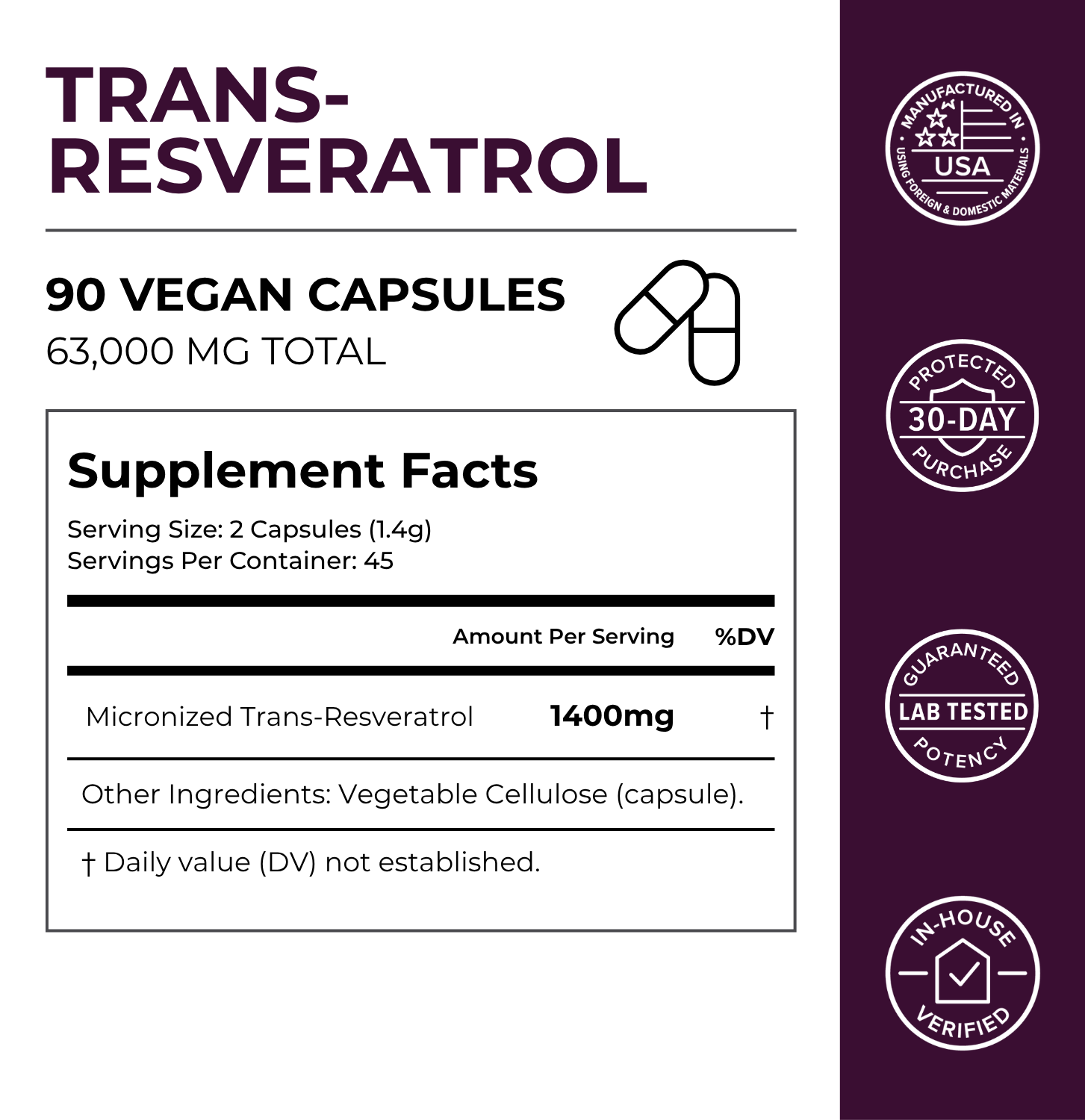
This is the label image linked by the live product record when reviewed on 10 September 2026.
Serving size and daily directions are listed separately. A dose similarity is not evidence that a different formula produces the same outcomes.
Labels and listings can change. Check the package you receive and discuss individual use with a qualified clinician.
Supplement Facts: Two capsules: 600 mg nicotinamide adenine dinucleotide plus 600 mg micronized trans-resveratrol.
Directions: Directions: two capsules daily. The 1,200 mg total is the sum of two ingredients, not 1,200 mg NAD+.
Research comparison: Direct NAD+, not NMN or NR. One marketing-image alt text mentions NMN, but Supplement Facts names NAD. No matching combination trial was identified.
Current product listing · Original label image
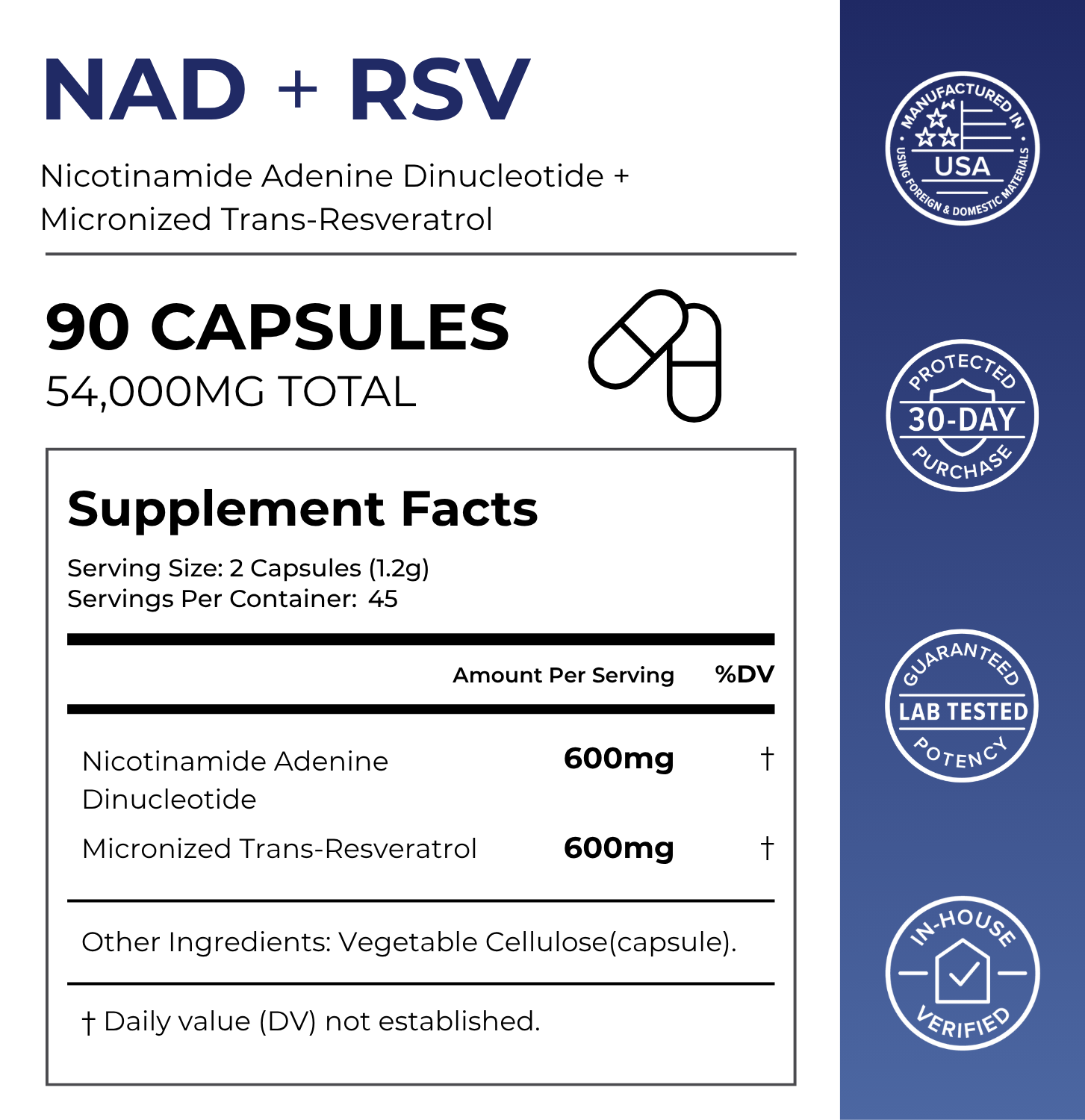
This is the label image linked by the live product record when reviewed on 10 September 2026.
Serving size and daily directions are listed separately. A dose similarity is not evidence that a different formula produces the same outcomes.
Labels and listings can change. Check the package you receive and discuss individual use with a qualified clinician.
SAFETY AND REALISTIC EXPECTATIONS
Concentrated resveratrol can cause gastrointestinal symptoms and may increase bleeding risk with anticoagulants or antiplatelet medicines. Potential drug-metabolism interactions and hormone-sensitive conditions warrant clinician review. Tell the surgical team before a procedure. People receiving cancer treatment should discuss it with their oncology team; safety findings in healthy adults do not settle safety during treatment. Pregnancy, breastfeeding and use in children are not established by these studies.
This page is educational, not a diagnosis, treatment plan or individualized dose recommendation. Do not stop prescribed treatment or replace established care on the basis of a biomarker result. “No significant difference” does not prove two treatments are equivalent, and “well tolerated” in a small trial does not rule out rare harms.
Bring the full ingredient list, medicines and health history to a clinician or pharmacist. In a blend, the safety question concerns every ingredient together, not only the name on the front label.
REFERENCES AND ACCESS
Links lead to primary publications or systematic reviews. Access limitations are stated rather than filled with assumed methods or outcomes. Product comparisons use the live product records and linked label images above.
A small metabolic signal, not weight loss. Access reviewed: Primary full text.
Open publication · Return to study summaryA higher dose did not reproduce the benefit. Access reviewed: Primary full text.
Open publication · Return to study summaryA small cognitive-test benefit in postmenopausal women. Access reviewed: Primary abstract.
Open publication · Return to study summaryWhy the diabetes reviews do not all agree. Access reviewed: Systematic review, public summary.
Open publication · Return to study summaryA broader review found selected glucose benefits. Access reviewed: Systematic review, abstract.
Open publication · Return to study summary
