A heart-failure signal
CoQ10 reduced a composite of serious cardiovascular events in Q-SYMBIO. Participants were patients receiving medical treatment, not healthy adults taking an energy supplement.
 SCIENCE / COQ10
COQ10 · HUMAN ORAL RESEARCH
CoQ10 helps cells make energy. Human research is most compelling in specific clinical settings, not as a promise of more energy for everyone. The formulation, the population and the other ingredients matter.
Explore the findingsIngredient and research-formulation evidence. None of the cited studies tested a finished Neurogan product. Reviewed September 10, 2026.
FINDINGS
CoQ10 reduced a composite of serious cardiovascular events in Q-SYMBIO. Participants were patients receiving medical treatment, not healthy adults taking an energy supplement.
High-dose ubiquinol raised serum CoQ10 without reducing confirmed statin-associated muscle pain.
A small study found higher CoQ10 exposure after 21 days with purified piperine. Black pepper without a stated piperine percentage is not the same intervention.
STUDIES
01 / HEART FAILURE / POSITIVE LONG-TERM RESULT
Q-SYMBIO tested CoQ10 alongside standard heart-failure therapy. It provides a meaningful clinical signal, but it does not establish prevention in healthy adults. [1]
Patients took 100 mg three times daily or matching placebo. The intention-to-treat groups were 202 and 218 patients. The primary long-term composite included cardiovascular death, unplanned admission for worsening heart failure, mechanical-assist implantation or urgent transplantation. Early heart-failure admissions during the first 30 days were excluded from that endpoint.
There were 30 events among 202 CoQ10 recipients and 57 among 218 placebo recipients. The time-to-event hazard ratio was 0.50 (95% CI 0.32 to 0.80; p = 0.003). That hazard ratio is not identical to a simple percentage reduction in event counts.
The prespecified 16-week endpoints, including functional class, six-minute walk and NT-proBNP, did not show significant between-group changes. Recruitment stopped below the planned 550 participants because enrollment was slow. The study took place before some current heart-failure therapies became routine. Do not replace prescribed care with CoQ10.
02 / STATIN MUSCLE PAIN / NULL
In patients whose muscle symptoms were confirmed during blinded statin testing, CoQ10 did not improve pain, strength or aerobic performance. [2]
Investigators first challenged people with simvastatin and placebo to verify that symptoms occurred specifically with the statin. In the supplementation phase, reported pain outcomes used 20 CoQ10 and 18 placebo participants, not the full randomized 41. A later crossover subset included 24 participants.
Pain severity and interference increased during simvastatin treatment regardless of assignment (treatment comparisons p = 0.53 and 0.56). Serum CoQ10 rose, but that laboratory response did not produce symptom relief. This page does not graph blood-level change as a pain benefit. Full outcome dispersion was not independently reviewed beyond the abstract.
The result applies to this high-dose ubiquinol regimen and these patients. It is one reason not to assume that restoring a blood marker fixes the symptom. Discuss muscle pain with the prescriber rather than stopping a statin on your own.
SUPPORTING INGREDIENTS
The energy-chain cofactor studied in Q-SYMBIO.
A purified pepper alkaloid studied for CoQ10 blood exposure.
A separate lipid mediator studied for symptoms such as joint pain.
03 / PIPERINE / ABSORPTION, NOT EFFICACY
Badmaev and colleagues reported approximately 30% greater CoQ10 plasma exposure with 120 mg CoQ10 plus 5 mg piperine versus CoQ10 plus placebo after 21 days. [3]
The publisher preview describes 12 healthy men, ages 20 to 47, and a black-pepper extract containing at least 98% piperine. The accessible material does not make the analyzed denominator for each repeated-dose endpoint sufficiently clear to draw a participant-level chart.
The 21-day area-under-the-curve result was significant (p = 0.0348); single-dose and 14-day differences were not significant. Exact confidence intervals and outcome variability were not available in the preview. The reported approximately 30% difference is exposure in blood, not 30% greater energy, heart protection or symptom relief.
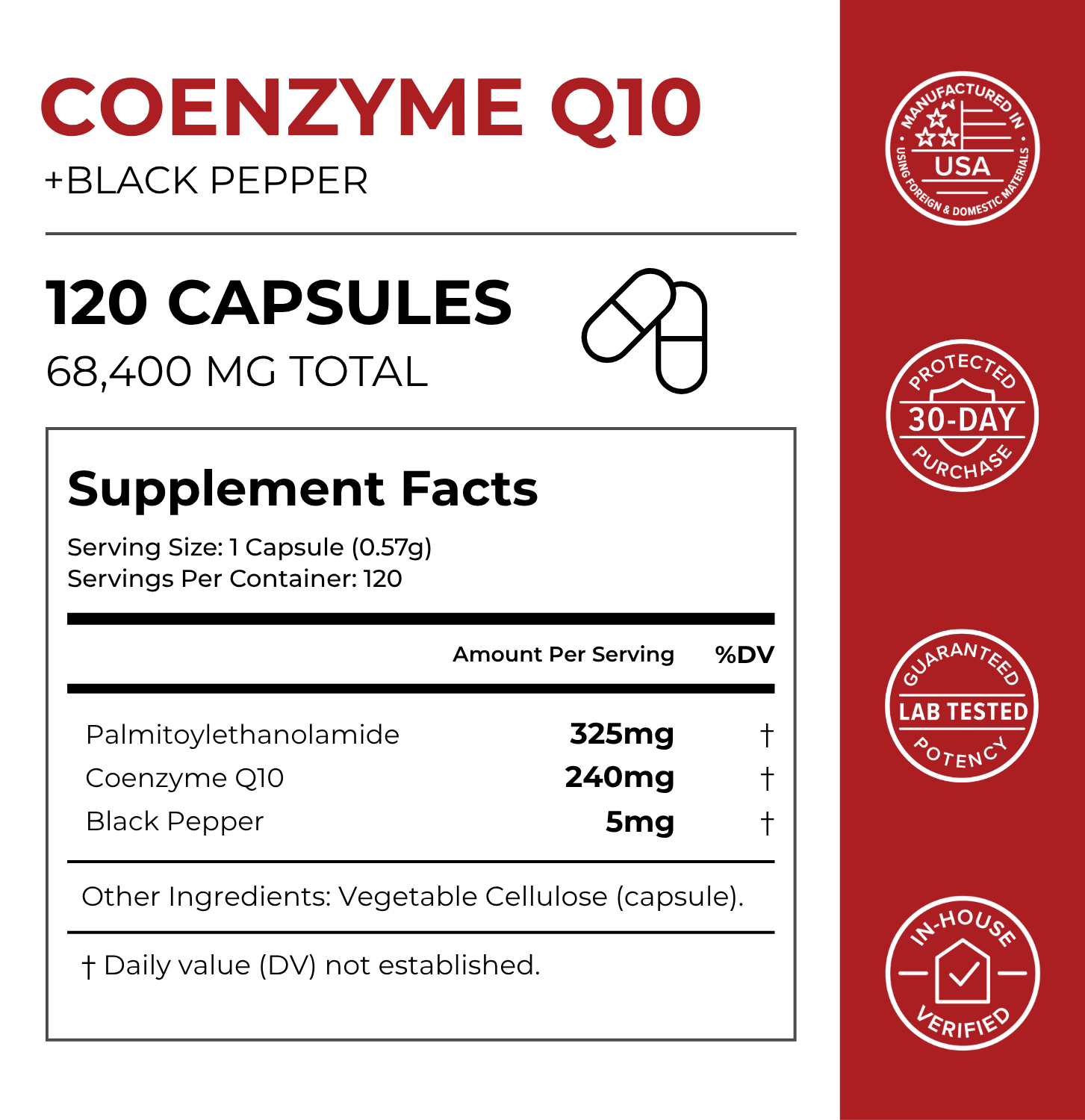
The Neurogan label lists 5 mg black pepper without a piperine standardization. That cannot be equated to 5 mg purified piperine. The study also did not include PEA or test the finished Neurogan blend. Because piperine can alter exposure to other substances, people using medicines should ask a pharmacist about concentrated pepper ingredients.
04 / PEA / SEPARATE-INGREDIENT EVIDENCE
A randomized PEA trial reported improved knee-osteoarthritis symptom scores versus placebo. That supports a separate PEA research lane, not the efficacy of a CoQ10 combination. [4]
PEA was taken in divided twice-daily doses. Total WOMAC symptom scores favored both doses versus placebo (p = 0.0372 for 300 mg; p = 0.0012 for 600 mg). Pain and stiffness findings also favored PEA; the reported function benefit was in the 600 mg group.
The accessed abstract does not supply group mean changes, confidence intervals or endpoint-specific analyzed n, so no numerical benefit chart is drawn. Formulation details and dose schedule must be matched before applying the result. The CoQ10 capsule contains 325 mg PEA, but a similar-looking number does not establish comparable performance or a combined effect.
PRODUCT COMPARISON
| Form | Amount / evidence | What carries over? |
|---|---|---|
| Coenzyme Q10 Capsules | Per 1 capsule: CoQ10 240 mg, PEA 325 mg, black pepper 5 mg. | The label gives individual ingredient amounts. Piperine percentage and CoQ10 formulation equivalence to the trials are not established. |
| Q-SYMBIO research formulation | CoQ10 100 mg three times daily, alongside heart-failure care. | Different daily dose and schedule. No PEA or black-pepper blend tested. |
| Pro+ liposomal formula | Page lists 120 mg liposomal CoQ10 per two capsules, with four other components. | Complex wording needs reconciliation with active content. Do not substitute this amount for 120 mg of a studied standalone preparation. |
What the current product information confirms: the live ingredient graphic and ingredient list name pomegranate extract, CoQ10, PQQ, spermidine and Akkermansia. The page lists 800 mg liposomal pomegranate extract, 120 mg liposomal CoQ10, 40 mg liposomal PQQ and 40 mg liposomal spermidine, plus 2 billion AFU Akkermansia, per suggested two-capsule serving.
What remains unresolved: a readable, standalone Supplement Facts panel was not available in the current live image gallery reviewed here. The page describes phospholipid complexes, so these listed masses should not all be assumed to represent isolated active material. The linked lot certificate names PQQ disodium salt and spermidine 3HCl, and uses a different pomegranate specification from the page. Confirm the bottle label and lot certificate before comparing an active dose with a trial.
A certificate of analysis is a quality record, not a trial of absorption, clinical benefit or the combined formula. No trial cited here tested Pro+.
Product information: [6] [7] [8]. Open the CoQ10 Supplement Facts image.
SAFETY
CoQ10 can cause digestive upset or insomnia and may interact with warfarin and insulin. It may not be compatible with some cancer treatments. A pharmacist should review the whole formula, including black pepper, rather than CoQ10 alone. Pregnancy, breastfeeding and use in children require individual medical advice because these studies do not establish safety in those groups. [5]
No. It participates in mitochondrial energy production, but that biological role is not proof of a noticeable energy boost in a healthy person.
No. The relevant small study used purified piperine and found a significant result only in its 21-day protocol. A label that lists black pepper without standardization cannot inherit that numerical result.
The cited confirmed-myalgia trial found no benefit for high-dose CoQ10 alone. It did not test this blend. New muscle pain deserves clinical review, not an assumption that a supplement will resolve it.
READ THE INGREDIENT. CHECK THE FORMULA.
Human findings are most useful when the dose, preparation, population and outcome match the question you are asking.
SOURCES & ACCESS
This is a focused research review, not an exhaustive systematic review. Primary studies are distinguished from reviews, safety guidance and manufacturer records. Source-access limits are noted rather than filled in with estimated results.
Primary full text accessed through publisher extraction. Tables and trial methods reviewed.
Read source 1 ↗Primary abstract accessed. Outcome-specific denominators are reported in the abstract.
Read source 2 ↗Primary abstract and publisher preview. Complete endpoint-specific denominators and dispersion not available in the accessible preview.
Read source 3 ↗Primary publisher abstract. Full numerical outcome tables not accessed.
Read source 4 ↗Government evidence and safety resource. Not a primary trial.
Read source 5 ↗Live product record and Supplement Facts image. Manufacturer information, not independent efficacy evidence.
Read source 6 ↗Live product page, ingredient graphic and listed serving amounts. Standalone facts panel unavailable in gallery.
Read source 7 ↗Manufacturer-linked laboratory certificate, issued June 18, 2026. Not a clinical study.
Read source 8 ↗