Meet the body’s needs
Vitamin C is essential. Correcting inadequate intake is a different goal from taking high doses after needs are met.
 SCIENCE / VITAMIN C
VITAMIN C · HUMAN ORAL RESEARCH
Vitamin C supports collagen formation, normal immune function and iron absorption. Liposomal delivery asks a different question: can a particular formulation put more vitamin C into the bloodstream? That does not automatically mean better health outcomes.
Explore the findingsIngredient and research-formulation evidence. None of the cited studies tested a finished Neurogan product. Reviewed September 10, 2026.
FINDINGS
Vitamin C is essential. Correcting inadequate intake is a different goal from taking high doses after needs are met.
A tested liposomal preparation increased short-term blood exposure versus ordinary oral vitamin C in 11 adults.
A large long-term vitamin C trial found no reduction in major cardiovascular events. It tested ordinary ascorbic acid, not liposomes.
STUDIES
01 / LIPOSOMAL DELIVERY / CROSSOVER TRIAL
Each person tried placebo, ordinary oral vitamin C, liposomal oral vitamin C and intravenous vitamin C on separate visits. The liposomal oral preparation produced more circulating vitamin C than the ordinary oral dose, but much less than intravenous delivery. [1]
Visits were separated by at least seven days. Blood samples tracked vitamin C over four hours. Participants were predominantly women (9 of 11); mean age was 53 ± 2 years and BMI 34.1 ± 1.0 kg/m², reported as mean ± standard error.
The oral liposomal AUC was 10.3 ± 0.9 mg/dL·h versus 7.6 ± 0.4 for ordinary oral vitamin C and 3.1 ± 0.4 for placebo. These are reported means ± standard errors, not the range of individual responses. The liposomal versus ordinary comparison had p = 0.002.
After three hours, investigators used a blood-pressure cuff to temporarily stop forearm blood flow, then measured a blood marker of lipid oxidation after flow resumed. All vitamin C routes prevented the rise seen with placebo. Liposomal vitamin C was not superior on that oxidative-stress endpoint.
The study was acute, small and formulation-specific. There was no empty-liposome control. It did not test colds, skin appearance, wound healing, long-term disease risk or Neurogan’s capsules. A 4 g research dose is not a routine-use recommendation.
The same 4 g of vitamin C via different delivery routes.
Liposomal oral exceeded ordinary oral exposure.
No superior protection with liposomes on the measured TBARS response.
CLINICAL OUTCOMES
02 / CARDIOVASCULAR PREVENTION / NULL
The Physicians’ Health Study II found no cardiovascular-prevention benefit from daily vitamin C in middle-aged and older male physicians. [2]
This was a double-blind factorial trial: vitamin C was randomized separately from vitamin E, beta-carotene and a multivitamin. The primary cardiovascular endpoint was nonfatal myocardial infarction, nonfatal stroke or cardiovascular death.
The vitamin C hazard ratio for major cardiovascular events was 0.99 (95% CI 0.89 to 1.11; p = 0.91). A value of 1 means no difference. The confidence interval includes 1, so the trial did not establish a reduction.
Most participants did not have prior cardiovascular disease, and the population was not selected for vitamin C deficiency. This does not argue against adequate nutrition or treating deficiency. It also does not directly test liposomal vitamin C. Rather, it shows why an antioxidant role alone is insufficient evidence for a disease-prevention promise.
95% confidence interval: 0.89 to 1.11. The interval includes no difference (1.00). Ordinary vitamin C versus placebo, not a liposomal trial. [2]
NUTRITION
Vitamin C is required for normal collagen synthesis. That requirement does not establish that extra vitamin C improves wrinkles when intake is already adequate.
Vitamin C supports normal immune function. NIH’s evidence summary does not support starting it after cold symptoms as a reliably effective way to shorten or reduce a cold.
Vitamin C helps absorb nonheme iron from plant foods. People with iron-overload disorders should discuss high-dose use with a clinician.
For most adults, the U.S. recommended dietary allowance is 90 mg/day for men and 75 mg/day for women. Pregnancy and lactation have different requirements; people who smoke need an additional 35 mg/day. These are nutritional intake recommendations, not a dose-response curve for supplement benefits. [3]
PRODUCT COMPARISON
| Form | Amount / evidence | What carries over? |
|---|---|---|
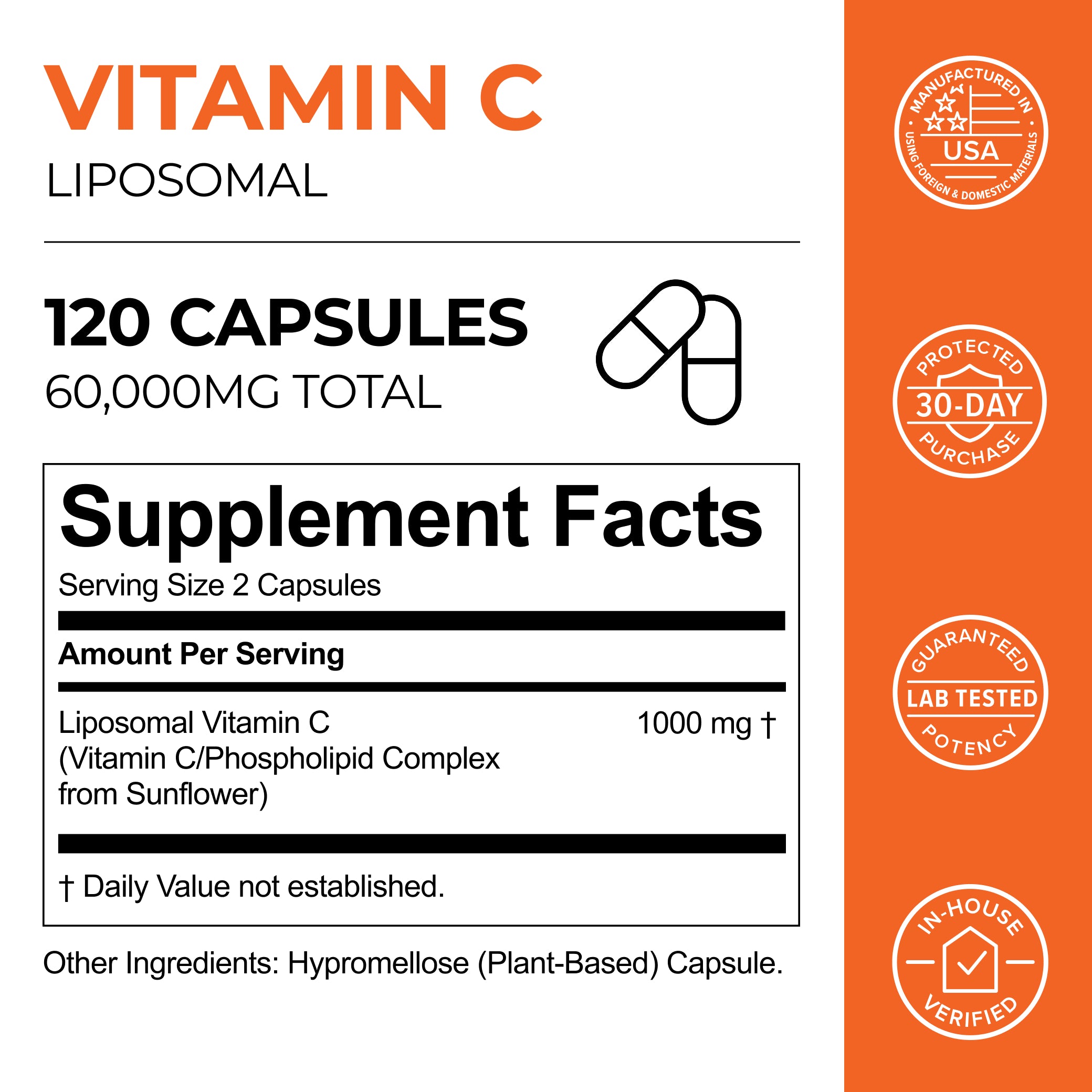
| Current Supplement Facts image | Serving size: 2 capsules. Liposomal Vitamin C 1,000 mg, described as a vitamin C/phospholipid complex from sunflower. | The image does not separately quantify active ascorbic acid versus carrier mass. Do not equate 1,000 mg complex with 1,000 mg active vitamin C without clarification. |
| Product description | Says each capsule delivers 1,000 mg, while suggested use is two capsules. | This conflicts with the 1,000 mg per two-capsule facts image. The discrepancy should be resolved before choosing a dose. |
| Davis research formulation | 4 g vitamin C in an oral liposomal preparation; acute crossover experiment. | Not this capsule or delivery system. Neither an absorption multiplier nor superior tolerance is established for the Neurogan product. |
| PHS II formulation | 500 mg/day synthetic ascorbic acid. | Long-term disease endpoints, but not liposomal delivery. |
[4] Open the current Supplement Facts image. Label image reviewed September 10, 2026. A laboratory or formulation specification is needed to resolve the active-to-complex ratio.
SAFETY
High vitamin C intakes can cause diarrhea, nausea and abdominal cramps. The U.S. adult tolerable upper intake level is 2,000 mg/day from all sources, not a target dose. Discuss supplementation if you have kidney disease, a kidney-stone history or hereditary hemochromatosis. People receiving chemotherapy or radiation should consult their oncology team before high-dose antioxidants. Do not use a complex’s total mass to calculate active vitamin C intake until its composition is clear. [3]
Not necessarily. Some preparations produce more vitamin C in blood. The small trial here did not find better protection on its measured oxidative-stress endpoint. Clinical benefit must be tested separately.
No. They are delivery-system components. Their mass is not the same as the amount of ascorbic acid, and the current product label does not split the two amounts.
No. It was a supervised acute research dose above the adult daily upper intake level. It should not be copied into a routine simply because it appeared in a trial.
READ THE INGREDIENT. CHECK THE FORMULA.
Human findings are most useful when the dose, preparation, population and outcome match the question you are asking.
SOURCES & ACCESS
This is a focused research review, not an exhaustive systematic review. Primary studies are distinguished from reviews, safety guidance and manufacturer records. Source-access limits are noted rather than filled in with estimated results.
Primary full text. Reported AUC means and standard errors reviewed.
Read source 1 ↗Primary full text. Long-term randomized cardiovascular outcomes.
Read source 2 ↗Government nutrition and safety synthesis, not a single trial.
Read source 3 ↗Live product record and Supplement Facts image. Description and label do not agree on per-capsule dose.
Read source 4 ↗