Visual learning stayed steadier
In a year-long juice trial, only one of six memory measures showed a significant between-group difference. This was not broad memory enhancement.
 SCIENCE / POMEGRANATE
POMEGRANATE · HUMAN ORAL RESEARCH
Pomegranate supplies polyphenols that gut microbes can transform into urolithins. Research on juice and standardized extracts is worth reading on its own terms. Neither is interchangeable with a dose of finished urolithin A.
Explore the findingsIngredient and research-formulation evidence. None of the cited studies tested a finished Neurogan product. Reviewed September 10, 2026.
FINDINGS
In a year-long juice trial, only one of six memory measures showed a significant between-group difference. This was not broad memory enhancement.
A four-week standardized-extract pilot found no significant between-group difference in circulating urolithin A.
A precursor pathway depends on both plant chemistry and the gut microbiome. The product name alone cannot establish finished urolithin exposure.
PATHWAY
A mixture. Its mass does not tell you how much punicalagin, other ellagitannins or ellagic acid it provides.
Ellagitannins can release ellagic acid. Microbial metabolism can then produce different urolithins.
A downstream molecule. A direct supplement supplies it rather than relying on precursor conversion.
A formula may contain pomegranate without containing finished urolithin A. Adding a gut ingredient does not establish that non-producers become reliable producers, or that the formula reaches the exposure achieved in a direct-urolithin trial. Those questions need product-specific testing.
STUDIES
01 / JUICE / MEMORY
A year of pomegranate juice was associated with more stable visual learning than placebo. The effect was specific rather than a broad improvement across memory tests. [1]
Memory was measured at baseline, six months and twelve months using the Brief Visuospatial Memory Test-Revised and Buschke Selective Reminding Test. The main published conclusion concerns the ability to benefit from repeated exposure to visual information.
Only one of six cognitive measures showed a significant between-group difference. The juice group remained statistically stable on that learning measure while placebo declined. Other visual-memory and verbal-memory outcomes did not show significant group differences. It is more accurate to describe preservation on a selected endpoint than improved memory in general.
The paper reports 261 randomized and 200 completers (98 juice, 102 placebo). Its allocation and dropout descriptions do not reconcile cleanly across sections, so this page uses the explicitly reported total and final-completer counts rather than calculating arm-specific attrition. No effect-size chart is drawn from an abstract or a conference report.
The studied juice provided 368 mg punicalagins, 93 mg anthocyanins, 29 mg ellagic acid and 98 mg other tannins per daily serving. These chemical amounts, not the word pomegranate alone, help define the intervention. The trial did not test a liposomal extract or Pro+.
One significant between-group memory finding; the juice group remained steadier.
No significant group differences on the other five measures.
Dementia prevention, lifespan extension or benefit from this supplement blend.
02 / STANDARDIZED EXTRACT / GUT PILOT
A standardized pomegranate extract changed some gut-related measurements, but the circulating urolithin A comparison was not statistically significant. [2]
The extract supplied 75 mg punicalagin per daily dose. Fourteen participants were randomized to each arm; only eight extract and ten placebo participants completed. This attrition and the short duration limit confidence.
Reported urolithin A increases were 6.6% with extract and 1.1% with placebo (p = 0.13). The result did not establish a between-group benefit. These percentages are not the fraction of participants who became urolithin producers. Exact uncertainty intervals are not supplied with this summary, so they are not converted into a benefit chart.
Propionate increased in the extract group, but acetate did not reach significance; overall microbial diversity did not change. Multiple exploratory microbial and metabolite analyses do not demonstrate improved symptoms or disease outcomes. A rise in a microbial metabolite is not automatically a health benefit.
03 / DIETARY CONVERSION / EXPOSURE
A randomized crossover study compared pomegranate juice with 500 mg directly supplied urolithin A. Conversion from juice varied substantially among people. [3]
The study was designed around blood exposure and producer status, not strength, mobility, disease risk or how people felt. The abstract reports that only about 40% significantly converted precursors after juice intake, while direct supplementation produced higher and more consistent exposure.
That population-level finding is not a prediction of what one person will produce from a particular extract. It also cannot prove the benefits of the Pro+ blend or show that Akkermansia solves the conversion bottleneck. The investigators had commercial involvement in direct urolithin A development, which is relevant to interpreting the comparison.
The present page does not borrow finished-urolithin A muscle or mitochondrial trial outcomes as pomegranate-extract outcomes. The interventions are chemically and pharmacokinetically different.
04 / EARLIER JUICE PILOT / PRELIMINARY
An earlier juice trial reported verbal-memory and brain-activation findings. The later year-long study did not reproduce a broad verbal-memory benefit. [4]
The trial paired memory testing with functional MRI during cognitive tasks. It reported improvement on a verbal-memory measure and greater task-related fMRI activity in juice recipients compared with placebo.
Brain activation is a physiological response, not a direct measure of improved daily functioning. The small sample and multiple assessments make this preliminary. Its short-term positive verbal finding should be read alongside the later, larger trial’s narrower result, rather than counted as confirmation of every memory claim.
PRODUCT COMPARISON
| Form | Amount / evidence | What carries over? |
|---|---|---|
| Pro+ product page | 800 mg liposomal pomegranate extract per two-capsule serving; part of a five-component formula. | Not 800 mg ellagic acid and not 800 mg finished urolithin A. The listed complex mass does not resolve the extract’s active profile. |
| Linked lot certificate | Pomegranate liposomal extract specification: at least 420 mg/capsule, with ellagic acid 57.8% in specification wording; result 445 mg/capsule. | The certificate and page’s 800 mg/serving do not directly agree. The meaning of extract mass versus assayed ellagic acid needs clarification. No urolithin A dose or conversion yield can be calculated from this. |
| Standardized-extract gut trial | 250 mg extract containing 75 mg punicalagin daily. | A chemically specified extract, not the same as a high-ellagic-acid complex. The urolithin A endpoint was not significant. |
| Memory trial juice | 236.5 mL/day with a measured mixture of punicalagins, anthocyanins, ellagic acid and other tannins. | Juice findings cannot be assumed for a capsule with a different polyphenol profile. |
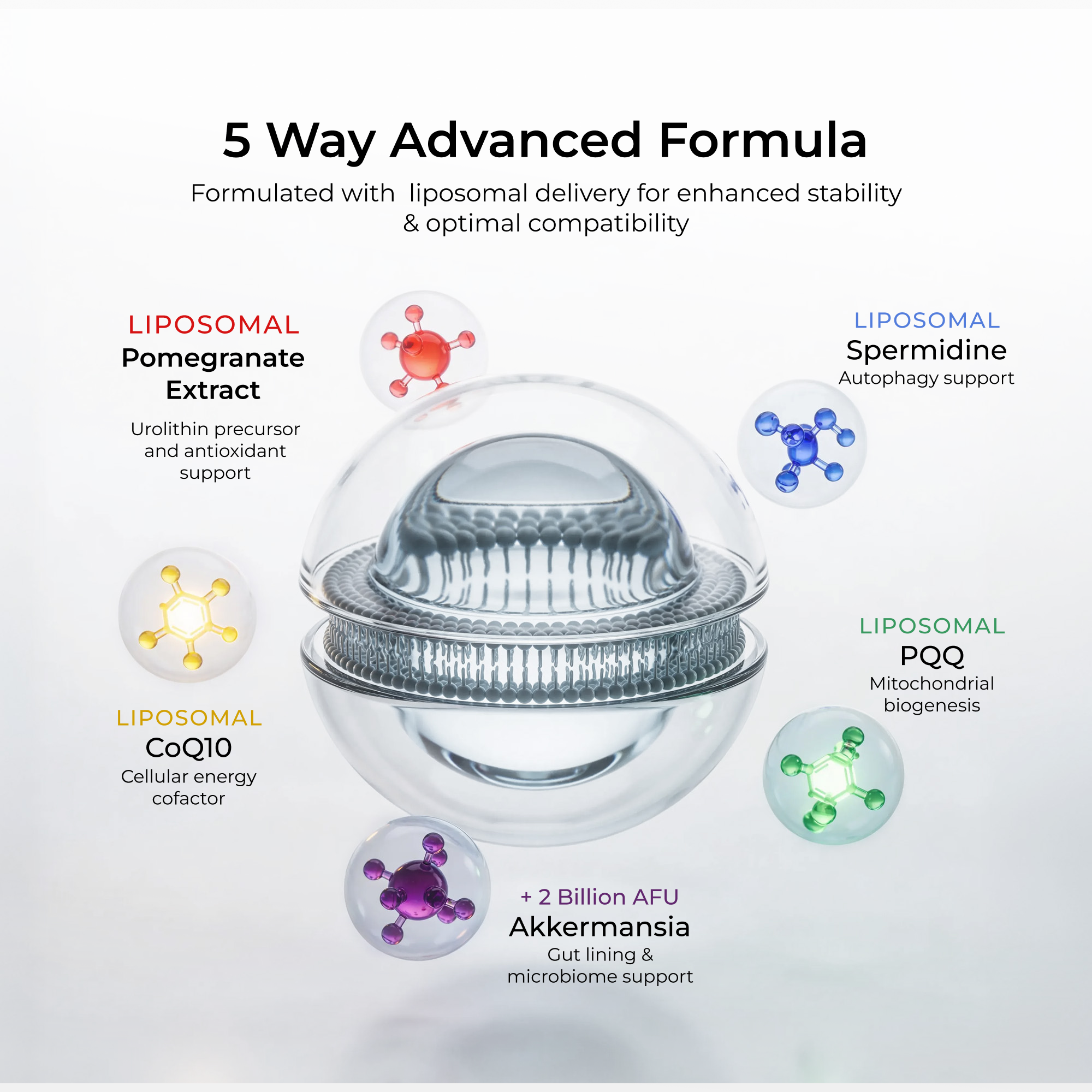
What the current product information confirms: the live ingredient graphic and ingredient list name pomegranate extract, CoQ10, PQQ, spermidine and Akkermansia. The page lists 800 mg liposomal pomegranate extract, 120 mg liposomal CoQ10, 40 mg liposomal PQQ and 40 mg liposomal spermidine, plus 2 billion AFU Akkermansia, per suggested two-capsule serving.
What remains unresolved: a readable, standalone Supplement Facts panel was not available in the current live image gallery reviewed here. The page describes phospholipid complexes, so these listed masses should not all be assumed to represent isolated active material. The linked lot certificate names PQQ disodium salt and spermidine 3HCl, and uses a different pomegranate specification from the page. Confirm the bottle label and lot certificate before comparing an active dose with a trial.
A certificate of analysis is a quality record, not a trial of absorption, clinical benefit or the combined formula. No trial cited here tested Pro+.
[5] [6] View the product ingredient graphic. Ingredient presence is confirmed in the live graphic and linked lot certificate; this is not a readable Supplement Facts panel.
SAFETY
Pomegranate juice is generally considered safe; extracts have a more limited safety record. Digestive symptoms and allergic reactions can occur. Do not assume concentrated peel or root preparations are interchangeable with juice or a standardized fruit extract. Ask a clinician about use with medicines, during pregnancy or breastfeeding, or before surgery. A five-component product also needs review of its PQQ, CoQ10, spermidine and Akkermansia components. [7]
The current ingredient graphic and list identify a precursor formula with pomegranate extract, CoQ10, PQQ, spermidine and Akkermansia. They do not list finished urolithin A as an ingredient.
No. Ellagitannins are larger polyphenols that can release ellagic acid. Gut microbes can metabolize ellagic acid further into urolithins. An assay for one is not automatically an assay for the others.
No reliable fixed conversion is established. Extract chemistry, microbial capability and timing all influence exposure. The current product information does not establish a finished-urolithin A yield.
READ THE INGREDIENT. CHECK THE FORMULA.
Human findings are most useful when the dose, preparation, population and outcome match the question you are asking.
SOURCES & ACCESS
This is a focused research review, not an exhaustive systematic review. Primary studies are distinguished from reviews, safety guidance and manufacturer records. Source-access limits are noted rather than filled in with estimated results.
Primary publisher full text accessed through extraction. No numerical test scores reconstructed from figures.
Read source 1 ↗Primary full text. Pilot completer counts and null urolithin finding reviewed.
Read source 2 ↗Primary full text and abstract. Pharmacokinetic research, not a clinical-benefit comparison.
Read source 3 ↗Primary full text. Small earlier pilot, kept separate from the later trial.
Read source 4 ↗Live product page and ingredient graphic. No readable standalone facts panel in current gallery.
Read source 5 ↗Manufacturer-linked laboratory certificate. Extract specification differs from the page amount.
Read source 6 ↗Government safety and evidence resource.
Read source 7 ↗