Selected memory tests
A 12-week study of PQQ disodium salt found favorable memory results, with different findings by age subgroup.
 SCIENCE / PQQ
PQQ · HUMAN ORAL RESEARCH
Pyrroloquinoline quinone is being studied for cognitive function and mitochondrial biology. Small human trials are interesting, but a laboratory signal is not the same as better endurance, and PQQ alone is not a five-ingredient blend.
Explore the findingsIngredient and research-formulation evidence. None of the cited studies tested a finished Neurogan product. Reviewed September 10, 2026.
FINDINGS
A 12-week study of PQQ disodium salt found favorable memory results, with different findings by age subgroup.
In a small training trial, PQQ changed a signaling protein without improving aerobic performance beyond training.
Older combination reports do not establish synergy or prove the current Pro+ formula. Their evidence must remain separate.
STUDIES
01 / PQQ ALONE / COGNITIVE TESTS
A manufacturer-funded randomized trial reported improved composite and verbal memory after 12 weeks of PQQ disodium salt. Age-stratified results were not identical across groups. [1]
The intervention was BioPQQ disodium salt in a cellulose capsule, not liposomal PQQ and not a CoQ10 combination. Computerized Cognitrax tests were administered at baseline, week 8 and week 12.
The analyzed sample in Table 1 comprised 62 adults. The younger subgroup had 29 participants (13 placebo, 16 PQQ); the older subgroup had 33 (18 placebo, 15 PQQ). These smaller groups make subgroup findings less secure than the headline sample size suggests.
Memory findings were reported at week 12; younger adults showed earlier signals on selected processing and flexibility measures. Multiple tests, repeated time points and subgroup analyses create more opportunities for positive results. This page does not reconstruct numerical scores or variance from plotted figures.
Outcomes were test performance, not daily independence, dementia incidence, mitochondrial number or lifespan. Manufacturer involvement and the modest sample make independent replication especially useful.
02 / PQQ ALONE / ATTENTION
An earlier placebo-controlled study reported a favorable Stroop interference result. A separate visual-spatial finding appeared only in participants with lower starting scores. [2]
The selective-attention result was a smaller change in Stroop interference ratios with PQQ than placebo. The Touch M visual-spatial result was described as improvement within the lower-baseline PQQ subgroup (initial score below 70), not a demonstrated overall benefit for every participant.
The accessed abstract does not provide exact group allocation, endpoint-specific n, numerical changes, dispersion or confidence intervals. It also does not establish a significant between-group difference for that Touch M subgroup. A preliminary blood-flow experiment should not be counted as an independent large clinical trial.
No abnormal blood or urine findings were reported during this study, but 12 weeks in a small selected population does not settle long-term safety.
03 / PQQ ALONE + TRAINING / MIXED
Both groups trained and improved fitness. Adding PQQ did not produce a significant extra aerobic-performance benefit. [3]
Participants were not endurance-trained. Researchers measured peak oxygen consumption, exercise-test duration, body composition and PGC-1α, a protein involved in signaling for mitochondrial biogenesis.
PGC-1α increased more with PQQ than placebo (p < 0.05). Aerobic-performance differences between groups were not significant (p > 0.05); fitness improved with training in both groups. The authors did not find an ergogenic or body-composition advantage.
Exact endpoint means, variability and analyzed group counts are not supplied in the accessed abstract. No numerical performance chart is constructed. A change in PGC-1α is not a direct count of newly created mitochondria and cannot be relabeled as a percentage energy increase.
EVIDENCE MAP
Selected memory and attention signals in small PQQ-alone trials.
A protein marker changed in the six-week training study.
Better aerobic performance, dementia prevention and longer life were not established.
A 2024 review describes older trials of 20 mg/day PQQ combined with 300 mg/day CoQ10, using cognitive outcomes over 12 or 24 weeks. The primary combination reports were not independently available for this review, so they are not used for numerical benefit claims here.
A positive combination-versus-placebo comparison does not by itself prove synergy. That requires a design and analysis capable of showing the combined effect exceeds the individual effects. These reports cannot establish that the current Pro+ formula, with different listed amounts and additional ingredients, improves cognition or mitochondrial function.
[4]PRODUCT COMPARISON
| Form | Amount / evidence | What carries over? |
|---|---|---|
| PQQ-alone research | 20 mg/day PQQ disodium salt in the cognitive studies; 20 mg/day PQQ in the exercise study. | PQQ identity, salt form and actual active exposure matter. These are not liposomal five-ingredient formulas. |
| Pro+ page amount | 40 mg liposomal PQQ per suggested two-capsule serving. | The page describes a phospholipid complex. Do not call this equivalent to 40 mg isolated PQQ without reconciling the active specification. |
| Linked Pro+ lot certificate | Names pyrroloquinoline quinone disodium salt; specification at least 20 mg/capsule, result 22 mg/capsule. | This suggests a salt-specific assay but does not resolve all complex-versus-active wording. It does not establish a clinical benefit or long-term safety at the serving exposure. |
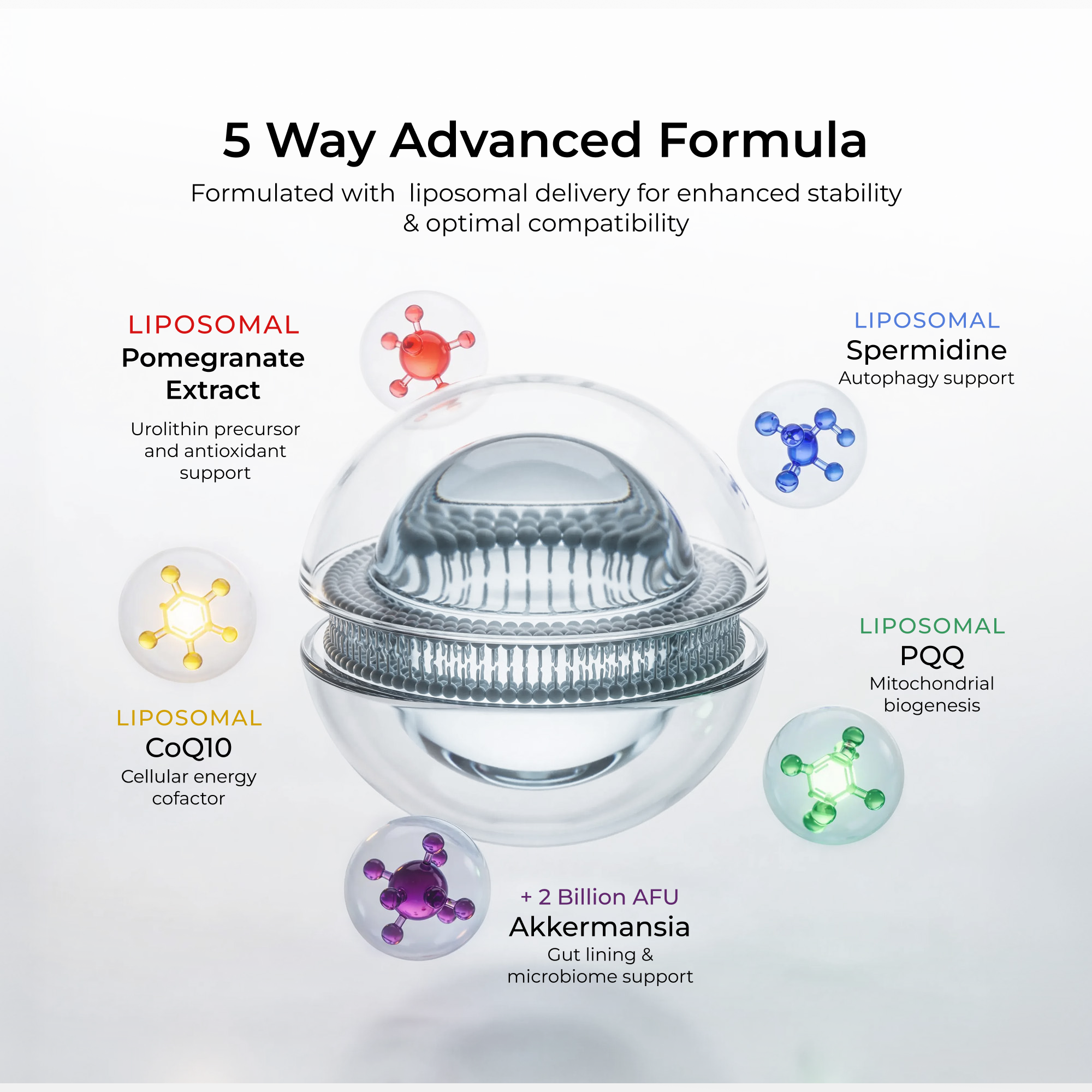
What the current product information confirms: the live ingredient graphic and ingredient list name pomegranate extract, CoQ10, PQQ, spermidine and Akkermansia. The page lists 800 mg liposomal pomegranate extract, 120 mg liposomal CoQ10, 40 mg liposomal PQQ and 40 mg liposomal spermidine, plus 2 billion AFU Akkermansia, per suggested two-capsule serving.
What remains unresolved: a readable, standalone Supplement Facts panel was not available in the current live image gallery reviewed here. The page describes phospholipid complexes, so these listed masses should not all be assumed to represent isolated active material. The linked lot certificate names PQQ disodium salt and spermidine 3HCl, and uses a different pomegranate specification from the page. Confirm the bottle label and lot certificate before comparing an active dose with a trial.
A certificate of analysis is a quality record, not a trial of absorption, clinical benefit or the combined formula. No trial cited here tested Pro+.
[6] [7] Open the live product ingredient graphic. This is an ingredient graphic, not a Supplement Facts panel.
SAFETY
EFSA assessed a specific PQQ disodium salt ingredient at up to 20 mg/day for healthy adults, excluding pregnant or breastfeeding women and children. That is a condition-specific safety assessment, not a universal upper limit or a finding that higher doses are unsafe. The Pro+ page’s 40 mg liposomal-PQQ wording and its salt-specific lot certificate require clarification before assuming exposure matches the assessed 20 mg/day. Long-term data and drug-interaction data remain limited. People with kidney disease, medical conditions or regular medicines should seek individualized advice. [5][6][7]
The cited human exercise trial measured a signaling protein associated with mitochondrial biogenesis. It did not establish a clinically meaningful increase in mitochondrial number or better endurance.
No dose-response claim follows from these studies. The product’s complex wording also prevents a simple active-dose comparison until the label and assay are reconciled.
Not without an appropriate PQQ-alone comparison. Likewise, PQQ-alone results cannot prove that adding CoQ10, spermidine, pomegranate and Akkermansia improves the effect.
READ THE INGREDIENT. CHECK THE FORMULA.
Human findings are most useful when the dose, preparation, population and outcome match the question you are asking.
SOURCES & ACCESS
This is a focused research review, not an exhaustive systematic review. Primary studies are distinguished from reviews, safety guidance and manufacturer records. Source-access limits are noted rather than filled in with estimated results.
Primary open-access publisher text accessed by web extraction; direct archive request blocked. No chart values digitized from figures.
Read source 1 ↗Primary PubMed abstract. Detailed effect sizes, dispersion and allocation counts not available in accessed abstract.
Read source 2 ↗Primary PubMed abstract and publisher preview. Full tables not accessed.
Read source 3 ↗Review, used only to identify older PQQ plus CoQ10 reports. Those primary combination reports were not independently accessed.
Read source 4 ↗Regulatory safety assessment. Conditions of use are not an efficacy recommendation.
Read source 5 ↗Live product record, page and ingredient graphic. Standalone Supplement Facts panel absent from current gallery.
Read source 6 ↗Manufacturer-linked laboratory certificate; salt identity differs from generic PQQ wording.
Read source 7 ↗